















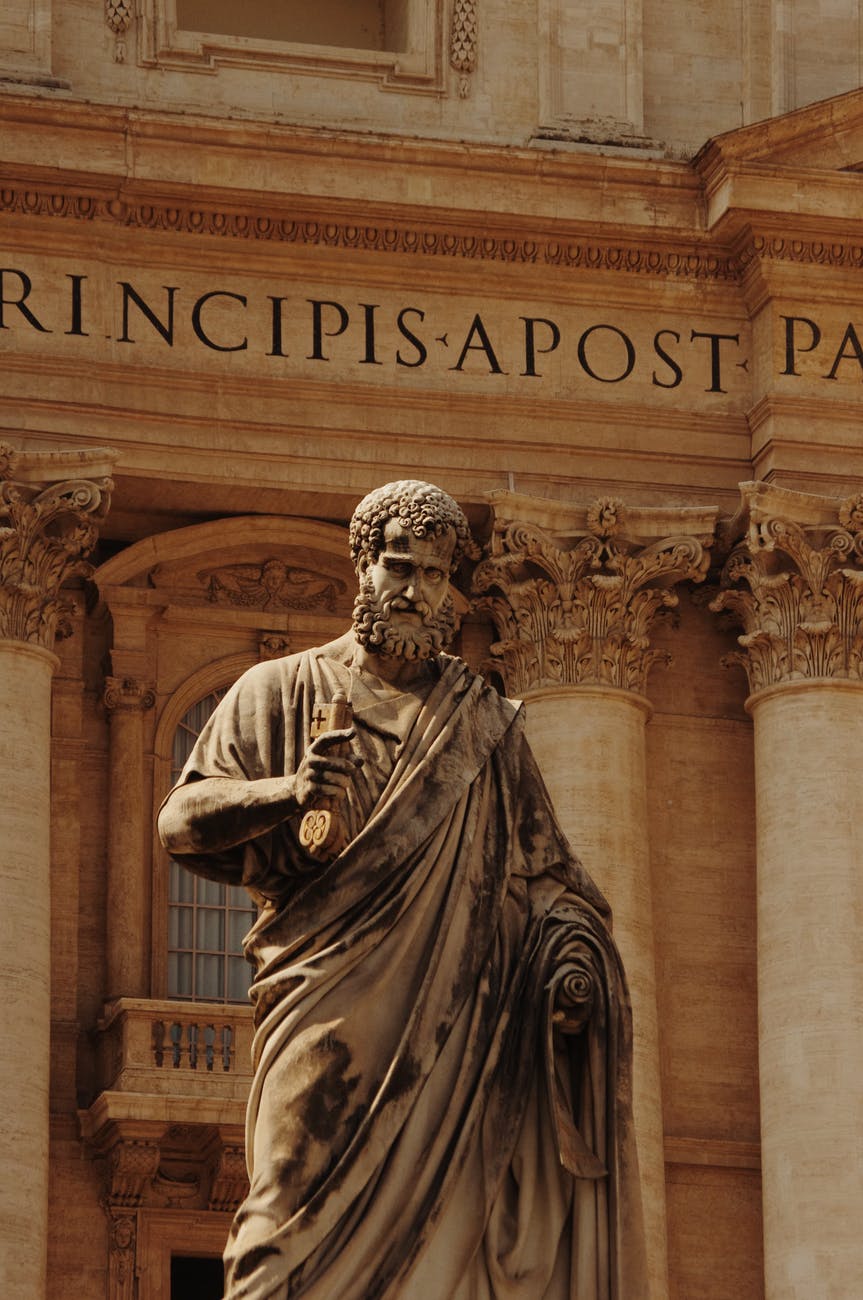

Essay on The Catholic Religion
Essay “The Catholic Religion” Diplomatic “Biblical Studies”
Essay on The Catholic Religion
Coming to Faith
lives c
I Believe…
done
the tra
in and
convic
We begin our profession of faith by saying: “I believe” or “We
believe.” Before expounding the Church’s faith, as confessed
in the Creed, celebrated in the liturgy, and lived in observance
of God’s commandments and in prayer, we must first ask what
“to believe” means. (CCC #26)
This a
God,
faith
Light,
I with
move
intelle
nd for
It’s an
Spirit
ake he
letting
“I believe…” What could we possibly say about these two little
words! What does it mean to say “I believe!” Are there not many
things we can believe in? Is believing just some personal choice to
believe in something that makes us feel better about ourselves? Do
we simply feel more secure if we choose to believe in something
Let’s b
d was
th the
hand
greater than ourselves?
The D
g and
And what about the question of “Why?” Why do I believe what I do? Is it just because this is what I was taught as a child? Is it simply because I have no reason not to believe what I was taught!
There
One t
occeds
want
Son is
funda
ncts. I
everyt
55. one
unsha
to the
your b
en
Throughout history there have been countless people who have tackled these questions. Some were among the most brilliant minds this world has known. Others have exercised very little intellectual power. But it’s true that the countless masses of people throughout history have pondered the question of belief. Some have done it in a very public way through books and articles. Some have discussed these matters at home with a spouse, children or friends. And others have kept these questions inside pondering them for themselves not sharing their reflections for fear of judgment or criticism.
You
Intere
for ha
there
desire
Take s
have
What has your journey of belief looked like? Have you looked deeply at the question of your beliefs? Do you even know what you believe? Have you tackled the tough questions of God, the creation of the Universe, the afterlife, the moral life, worship and the like?
somee
a false
yes, in
with t
happy
If you’ve pondered these questions and come to some sort of conclusion, then have you also looked deeply at that second question of “Why? Why do I believe this or that? Do I have a good reason for my heliefs? Or am I embarrassed or fearful to take a stand and make my convictions known? Coming to Know God
tuntial
If we are to love God, we must come to know Him. We cannot love someone we do not know. So how do we do this? How do we come to know God?
or one
T
g, etc..
speak
more
We are
There are two basic ways. Both ways bring us to knowledge of God, but the second way brings us much deeper into our personal knowledge of Him and is necessary for a true relationship with Him. Below are the two ways.
Beaut
en we
faced
aking
also so
have f
. For
recogn
Sure,
These
in love
the re
r. It’s
First, we come to know there is a God simply by natural deduction. In other words, our brains can figure it out by a process of reasoning. It just makes sense! As you will see, our natural reasoning process toward a God cannot help us arrive at the full picture of the Christian God we love and worship. But it can give us a start and point us in the right direction. Let’s start by looking at how this makes sense from the point of view of creation itself. There are several ways we can look at this, but we’ll just look at it from a couple of them. This may seem overly philosophical, but it’s important to understand nonetheless.
bodies
Deep
somew
must
us to
our
ve has
physic
o, the
When
is the
ourse
rc, we
this al
try to
point
love!”
nswer
canno
expres
that w
ains a
can be
One way to look at it is to realize that the Universe must have had a beginning. There was a beginning to time. How do we know this? Because it doesn’t make sense to say that the Universe simply always was with no beginning. Why? Because time moves in one direction. Forward. We can certainly imagine that time could go on (forward) infinitely. It’s rational to think that there could be no end to time. But what about the reverse! Is it rational to think that time could have what philosophers call an “infinite regress!” That is, u day before yesterday, and a day before that, and a day before that…. on and on and into infinity backwards? If you think too hard about this, your brain may hurt. It’s hard to comprehend this possibility and ultimately does not seem possible. So what’s the answer? The logical answer is that the Universe had to have a definite beginning. A starting point. But this begs the question, “How did it start?” And that’s where we get our answer. There must be a power that is capable of starting the Universe, creating it, setting it into motion, and doing this out of nothing. Some scientists call this the Big Bang. But we will call it God.
 Jacob Caldino Cardel